Tree Pruning in Urmston
Careful tree pruning and trimming that keeps trees healthy, safe and the right shape. Clean cuts at the right points, and every branch cleared away when we’re done. Around three miles from our Stretford base.
Tree Pruning for Urmston Gardens
Pruning keeps Urmston’s trees and its houses on speaking terms. The avenues through Davyhulme and Flixton were laid out leafy on purpose, and the garden trees that went in with the 1930s semis now sit close over bay windows, gutters and garage roofs. Most of our tree pruning here is clearance and balance: lifting branches off the roofline, easing growth away from wires, taking out deadwood before it drops, and letting daylight back into rooms that have gone dim behind a crown that no one has touched in twenty years.
We cover Urmston and the surrounding area: Urmston town centre, Flixton, Flixton village, Davyhulme, Woodsend and beyond (M41).
Read more about our tree pruning service, or see all our tree work in Urmston.
Get a Free Urmston Quote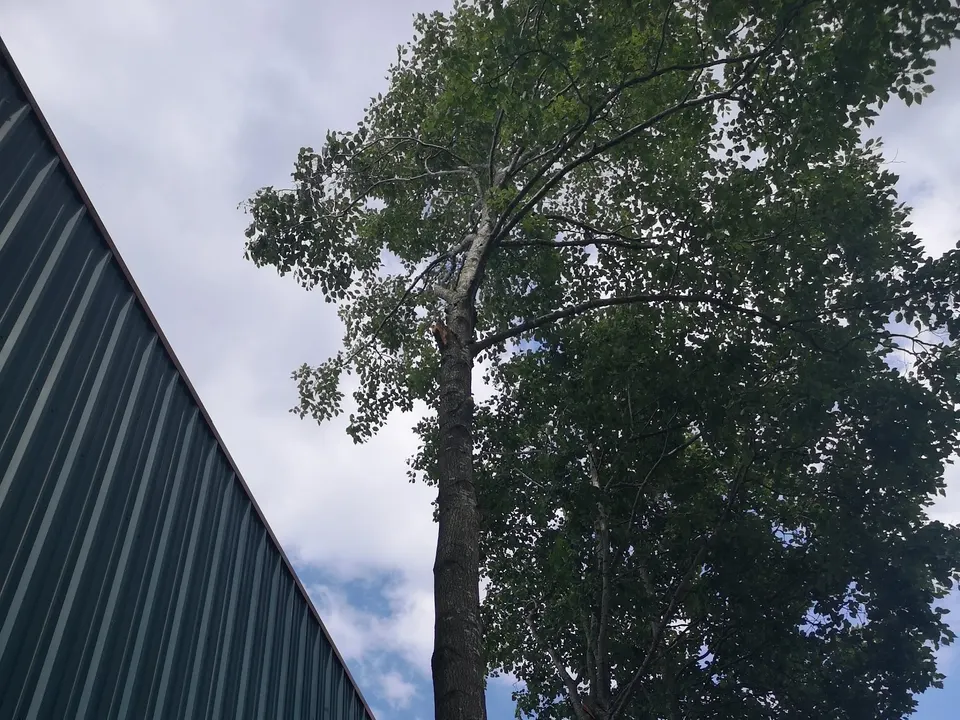
What’s Included
Timing matters as much as technique. Bird nesting season runs roughly February to August and active nests are protected under the Wildlife and Countryside Act, so we check every crown before cutting: work in season is fine, it just cannot disturb a live nest. And some trees need nothing at all. If yours only wants a light deadwood, or wants leaving alone for another couple of years, we will tell you that rather than invent a job.
- Deadwooding and removal of crossing or rubbing limbs
- Branches cut back off roofs, gutters, sheds and phone lines
- Overhanging growth trimmed back from next door and the street
- Thinning to let more light into the garden below
- Clean cuts at the branch collar, never flush cuts or stubs
- Nesting bird checks before any cutting, February to August
How It Works
Tree Pruning in Urmston, FAQs
Usually, yes. The law protects active nests, not the season itself, so we check the crown before we start. If a nest is occupied we work around it or come back later; if the tree is clear we carry on. Between February and August that check happens on every Urmston job, no exceptions.
Prune first, nine times out of ten. Thinning the crown or easing it back usually brings the light back for a fraction of the cost of removal, and you keep the tree. If it is the wrong tree in the wrong place we will say so on the visit, but shade on its own is rarely a reason to fell.
For most trees, late autumn and winter, while the tree is dormant and the bare branches let you see the structure. There are exceptions. Cherries, plums and other stone fruit should be pruned in summer to avoid silver leaf disease, and maples and birches bleed sap if cut in late winter, so they’re better left until midsummer. Deadwood can come out at any time of year. Tell us the species and we’ll tell you the right window.
Less than most people hope. A tree feeds itself through its leaves, so stripping a big share of the canopy in one visit starves and stresses it, and the tree answers with a rush of weak, fast regrowth that puts you back where you started. A good prune takes the deadwood, the problem limbs and a sensible amount of the rest. If a tree needs more off than that, the right job is a crown reduction, cut back to growth points so the tree stays healthy and natural looking, and we’ll quote it that way instead.
Only if it’s cut badly. Lopping branches off mid-limb leaves stubs that sprout dense clusters of weak, upright shoots, which is why topped trees look worse within a couple of years. Pruning back to a natural fork or to the branch collar doesn’t trigger that reaction. The tree seals the cut and carries on growing at its normal rate, so a tree pruned that way holds its shape for years while a hacked one needs doing again almost straight away.