Tree Pollarding in Greater Manchester
Willow, lime, poplar and plane cut back to their heads and kept there on a regular cycle. Straight advice on the trees pollarding suits and the ones it doesn’t.
Tree Pollarding
Pollarding is the old way of keeping a big-growing tree at a size that suits its spot. The tree is cut back to a framework of main branches, the regrowth comes, and every few years it all comes off again back to the same points, the pollard heads. Started young and kept up, that cycle can run for the whole life of the tree, which is why willow, lime, poplar and plane get managed this way along streets, beside rivers and in tight gardens where a full-sized tree would never fit.
People ring us asking for tree topping, so it’s worth being straight about the difference. Topping is what gives tree surgeons a bad name: one heavy cut through a mature crown that was never grown for it, leaving big open wounds that let decay in, and a rush of fast, weakly attached regrowth that comes back thicker and more dangerous than what was taken off. Pollarding is a planned cycle on a tree that was shaped for it, cut back to the same heads each time so the wounds stay small and the tree copes. If your tree is mature and has never been pollarded, a crown reduction that keeps its natural shape is almost always the better job, and we’ll tell you that at the quote rather than sell you the wrong cut.
A lapsed pollard is one that has missed its cycle. The poles that spring from the old heads are only weakly attached, and once they get long and heavy they start tearing out in storms, usually onto whatever sits underneath. Bringing one back under control is careful, staged work: sometimes one visit, sometimes two spread over a couple of years so the tree isn’t shocked. Species matter as much as timing. Beech, birch and most conifers don’t pollard at all, so if that’s what is growing in your garden the honest answer is a reduction or a removal, and we’ll quote for that instead. If the tree carries a preservation order or stands in a conservation area, we check before anything is cut and handle the council paperwork with you.
- Cyclical pollarding of willow, lime, poplar, plane and some sycamore
- New pollards started on young trees in the right spot
- Lapsed pollards brought back under control in careful stages
- Honest advice when crown reduction or removal is the better call
- TPO and conservation area checks, council paperwork handled with you
- All brash chipped and cleared, the garden swept before we go
How It Works
Get in touch
Call or message with a rough idea of the tree and its spot, photos help. We respond within 24 hours and sort a time to come and see it.
Look and written quote
Tim checks the species, the old heads if there are any, and the access, then tells you whether pollarding is the right cut for your tree. Your free written quote follows within 48 hours, with TPO and conservation area checks done before any work is booked.
The cut
A check for active nests first between February and August, then the regrowth comes back to the heads with clean cuts. On lapsed pollards the heavy poles are lowered in sections so nothing lands where it shouldn’t.
Cleared and swept
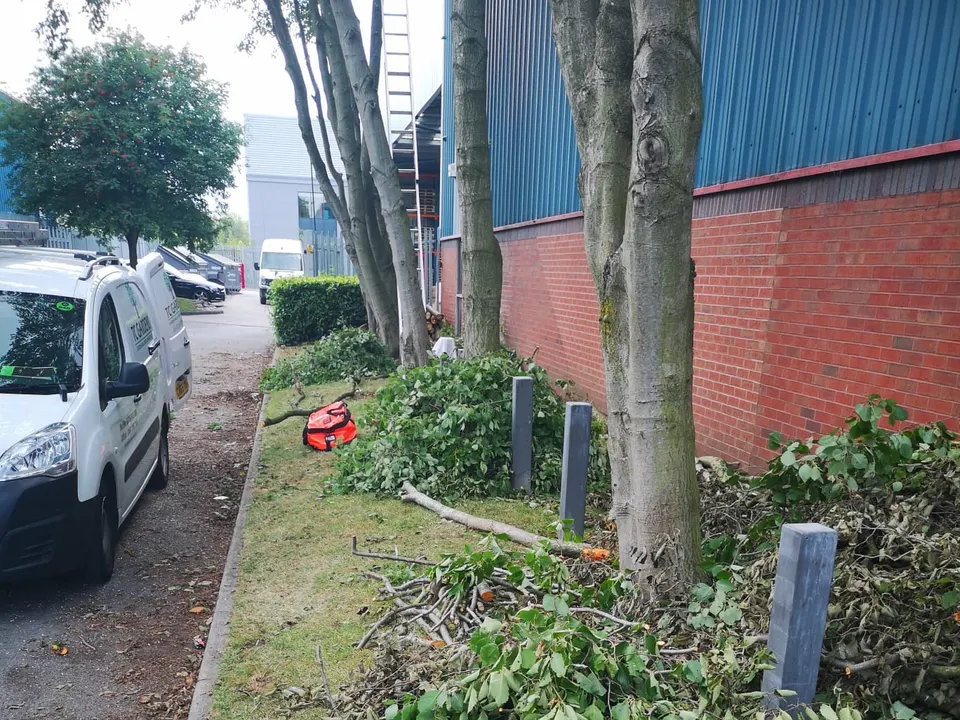
Brash chipped, timber cut and cleared, lawns raked and paths swept, so all that’s left is the tree at a manageable size again.
Pollarding FAQs
Willow, lime, poplar and plane are the classic pollarding species, and some sycamores take it well too. They regrow strongly from old wood, which is what the whole cycle relies on. Beech, birch, cherry and most conifers don’t, so cutting them back that hard just leaves wounds they can’t recover from. If yours is one of those, we’ll say so and quote for a crown reduction or a removal instead.
It depends on the species and how tidy you want it. Fast growers like willow and poplar usually want cutting every two to three years, while lime and plane can often stretch to four or five. The main thing is not to let the cycle slip, because the longer the regrowth gets, the heavier and weaker it becomes, and the bigger the job when someone finally has to deal with it.
Not on the right species. Willow, lime, poplar and plane answer the cycle by regrowing strongly, and a regularly pollarded tree can live as long as one that’s never been touched; some of the oldest trees in the country are old working pollards. What harms a tree is topping a species that can’t take it, or leaving a pollard so long that the heads split under the weight of the regrowth.
That’s a lapsed pollard, and it’s worth dealing with sooner rather than later. The regrowth on the old heads is only weakly attached, and the heavier it gets the more likely a pole is to tear out in wind. Most lapsed pollards can be brought back to their heads, sometimes in one visit, sometimes staged over a couple of years so the tree can cope, and we’ll tell you which yours needs when we quote.
Pollarding cuts everything back to fixed points on a bare framework and repeats it on a cycle, so the tree looks stark for a while after each cut. A crown reduction shrinks the whole crown while keeping the tree’s natural shape, cutting back to growth points rather than stubs, and you’d struggle to tell it had been done from the street. For a mature tree that’s never been pollarded, reduction is nearly always the right choice. Pollarding suits the species that take it, started early and kept up.